
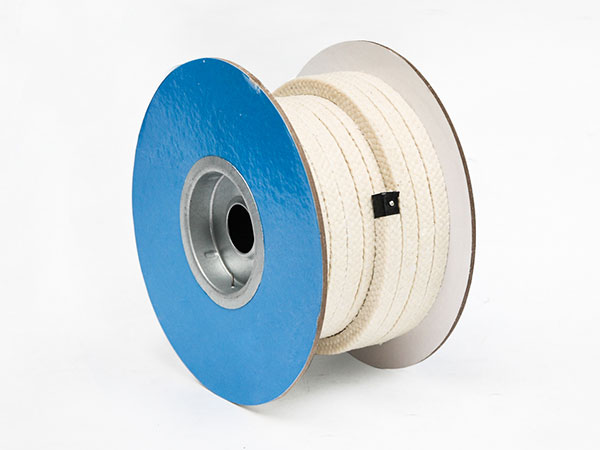
Aramid PTFE Packing braided from high-quality Aramid(Kevlar)yarns which are uniformly impregnated with PTFE dispersion. The braided packing shows good chemical resistance, high elasticity, and very low cold flow. It is wear-resistant but may damage the shaft if not used properly.
The aramid fiber can be braided in many types for different applications, such as Aramid PTFE Packing with lubricant for a slurry service application, Spun aramid fiber packing with economical use; PTFE packing with Aramid corner, Graphite PTFE Packing with Aramid Corner, GPTFE & Aramid in Zebra braided packing, etc.
Aramid PTFE packing is an interlocked, square-braided product made from Kevlar aramid fibers impregnated with PTFE dispersion and specially treated with a silicone-based compound for quick and easy break-in. Aramid fiber offers a unique combination of properties: High Tensile strength& chemical resistance, Lasting Resilience, Low Thermal Expansion, and Low Coefficient of Friction. The Aramid PTFE packing is a robust and versatile solution for demanding industrial environments, offering exceptional strength, chemical resistance, and durability. its unique properties make it ideal for handling abrasive and high-temperature media while ensuring long service life and ease of maintenance.
| Rotating | Reciprocating | Static | |
| Pressure | 25 bar | 100 bar | 200 bar |
| Shaft speed | 25 m/s | 1.5 m/s | |
| Temperature | -100~+280°C | ||
| PH range | 2~12 | ||
| Density | 1.3-1.4g/cm3 | ||
Aramid Fiber Packing Applications:
General-Purpose Packing: Widely used in various industrial fields, including chemical, petroleum refining, pharmaceutical, food, sugar, paper, and power industries.
Durable and Reliable: Suitable for abrasive media containing solid particles.
Recommended for: Superheated steam, solvents, liquefied gases, syrups, and other abrasive fluids.
Temperature Resistance: Can be used in hot water up to 160°C without the need for cooling fluid.
Versatile Usage: Can be used alone or combined with other braided packing materials, placed at both ends as anti-extrusion rings.